Boston Art Review // ArtWonk: Austerity Comes for the Biennale
The first Monday in May is for the insiders. The politics of attending are no doubt problematic: the cost, the climate impact, and the fact that simply showing up implicitly endorses the grim politics of the institution’s new leadership. I’m not talking about the Met Gala. On May 4, international art power brokers descended on another emblematic site of cultural caché recently impacted by Bezos: Venice.
The preview days of the Venice Biennale draw crowds of international culturati to take the pulse of the global power order as expressed through contemporary visual art. It’s as if the United Nations General Assembly and Eurovision had a baby—but make it art.
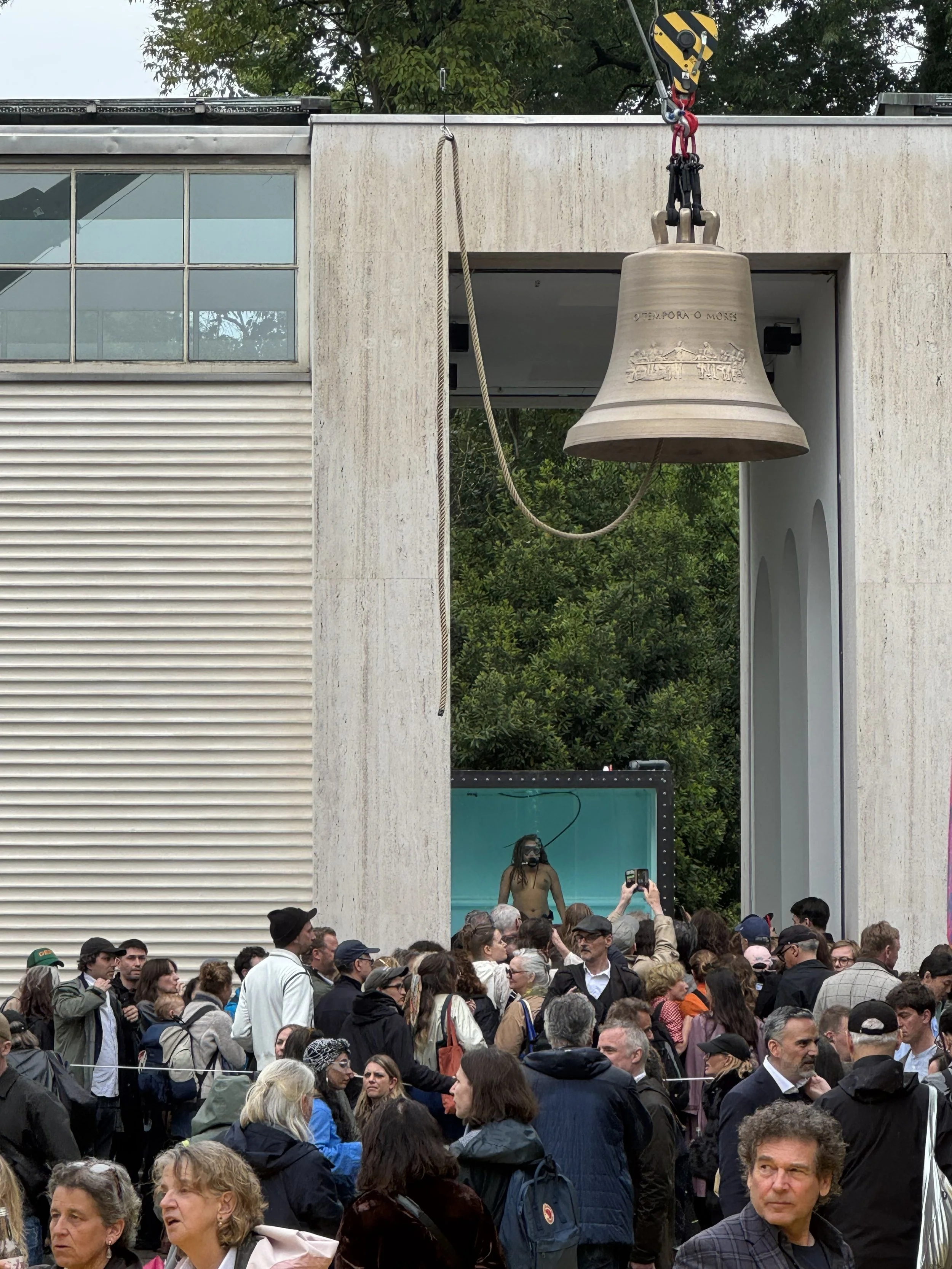
A few things unfolded as expected. The quick-hit critics’ reviews called out the Biennale’s national pavilion format as outdated. Alma Allen ushered in the Vichy era of the US pavilion. His presentation was widely and roundly panned—at least in part—for how cryptic he has been in explaining why he accepted the Trump administration commission. Protestors staged demonstrations at the Russian and Israeli pavilions, which both had significant armed police presence. Curiously, the US pavilion didn’t draw any protests.
Death was a regular spectre at the 61st Venice Biennale, titled “In Minor Keys.” The sudden passing of Koyo Kouoh, the curator of the central exhibition, in 2025, led to the decision to proceed with this exhibition posthumously, prompting critic Martin Herbert to question the possibility of a posthumous critique. Henrike Naumann, an artist representing Germany, passed away in February 2026. John Beadle, representing the Bahamas, passed away in 2024. Far more omnipresent, though, was a riff on Thomas Mann’s 1912 novella: “No death in Venice” slogans, wheatpasted and graffitied throughout Venice, demanded that the Biennale ban the US, Israel, and Russia from participating due to their ongoing attacks on civilians. On April 30, the prize jury of the Venice Biennale resigned in protest of the continued participation of Israel and Russia. By May 11, over 70 pavilion artists, curators, and exhibition staff recused themselves from consideration for the newly created Visitor Lion awards, which are replacing the Gold and Silver Lion prizes. Beyond the killings of civilians and journalists in Gaza, Lebanon, Iran, Sudan, and Ukraine regularly invoked over the week, there was also the pall of a more abstract death: that of the international art system.
European and US arts institutions have been reeling from fresh rounds of cuts to social and cultural spending. At the Giardini and Arsenale, this shift toward deeper austerity manifested most clearly in leaner hospitality and promotional swag budgets. Far from trivial, this points to how the international arts system, which has long struggled to translate the contributions of social good into economic logic, has benefited in recent decades from the largess of other government agenda goals, including development aid and democracy-building industries designed to promote Western values—and how cuts to these budgets mean cuts to the arts. Call it the SWAG index: So-long pro-Western Art Gatherings.